From Press Release
When financial gain depends on cooperation, we might expect that people would put aside their differences and focus on the bottom line. But new research suggests that people’s racial biases make them more likely to leave money on the table when a windfall is not split evenly between groups.
The findings are published in Psychological Science, a journal of the Association for Psychological Science.
“It has been suggested that race bias in economic decisions may not occur in a market where discrimination is costly, but these findings provide the first evidence that this assumption is false,” explain psychological scientists Jennifer Kubota and Elizabeth Phelps of New York University. “Our work suggests that after offers are on the table, people perceive the fairness of those offers differently — even when they are objectively identical — based on race.”
The research was inspired by the debt ceiling debates that raged on in the summer of 2011.
“Many members of both the House and Senate seemed willing to incur costs that would hurt their own constituents in order to vote along political lines,” say Kubota and Phelps. “The debate led us to wonder: Are people willing to punish members of another group when they perceive their behavior as unfair, even when exacting that punishment comes at a personal cost?”
The researchers decided that an important first step in understanding this phenomenon, given race-based financial disparities in the United States, would be to examine interracial economic decisions.
Source: APA
Link to full APA Press Release: The Cost of Racial Bias in Economic Decisions
Link to abstract for study published in Psychological Science: The Price of Racial BiasIntergroup Negotiations in the Ultimatum Game
Download pdf of The Price of Racial BiasIntergroup Negotiations in the Ultimatum Game (academic affiliation / subscription may be required)
Thursday, October 17, 2013

Personality, Gender, and Age in the Language of Social Media: The Open-Vocabulary Approach
Abstract:
We analyzed 700 million words, phrases, and topic instances collected from the Facebook messages of 75,000 volunteers, who also took standard personality tests, and found striking variations in language with personality, gender, and age. In our open-vocabulary technique, the data itself drives a comprehensive exploration of language that distinguishes people, finding connections that are not captured with traditional closed-vocabulary word-category analyses. Our analyses shed new light on psychosocial processes yielding results that are face valid (e.g., subjects living in high elevations talk about the mountains), tie in with other research (e.g., neurotic people disproportionately use the phrase ‘sick of’ and the word ‘depressed’), suggest new hypotheses (e.g., an active life implies emotional stability), and give detailed insights (males use the possessive ‘my’ when mentioning their ‘wife’ or ‘girlfriend’ more often than females use ‘my’ with ‘husband’ or 'boyfriend’). To date, this represents the largest study, by an order of magnitude, of language and personality.
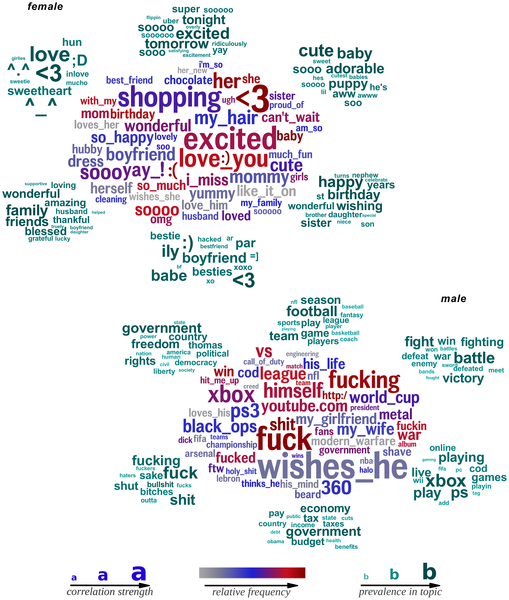 Source: PLoS ONE 8(9):
e73791.
doi:10.1371/journal.pone.0073791
Source: PLoS ONE 8(9):
e73791.
doi:10.1371/journal.pone.0073791
Link to Personality, Gender, and Age in the Language of Social Media: The Open-Vocabulary Approach
Download pdf of Personality, Gender, and Age in the Language of Social Media: The Open-Vocabulary Approach
We analyzed 700 million words, phrases, and topic instances collected from the Facebook messages of 75,000 volunteers, who also took standard personality tests, and found striking variations in language with personality, gender, and age. In our open-vocabulary technique, the data itself drives a comprehensive exploration of language that distinguishes people, finding connections that are not captured with traditional closed-vocabulary word-category analyses. Our analyses shed new light on psychosocial processes yielding results that are face valid (e.g., subjects living in high elevations talk about the mountains), tie in with other research (e.g., neurotic people disproportionately use the phrase ‘sick of’ and the word ‘depressed’), suggest new hypotheses (e.g., an active life implies emotional stability), and give detailed insights (males use the possessive ‘my’ when mentioning their ‘wife’ or ‘girlfriend’ more often than females use ‘my’ with ‘husband’ or 'boyfriend’). To date, this represents the largest study, by an order of magnitude, of language and personality.
Link to Personality, Gender, and Age in the Language of Social Media: The Open-Vocabulary Approach
Download pdf of Personality, Gender, and Age in the Language of Social Media: The Open-Vocabulary Approach
Monday, October 14, 2013
Science Special Issue: Communication in Science: Pressures and Predators
Science's Special Issue on Communication in Science: Pressures and Predators includes free news and reviews on the lack of scrutiny
at open-access journals, the rarity of published negative studies, and publishing sensitive data.
 Entire special issue available online
Thursday, October 10, 2013
Smithsonian's interactive before-and-after maps of American cities
From the Discovery News Blog:
In an elegant cartographic union of old and new, Smithsonian's interactive before-and-after maps of American cities let users peer into the past and see how it compares with the present. The magazine dug through Cartography Associates President David Rumsey's collection of over 150,000 maps and selected six vintage renderings of the following cities: Chicago, Denver Los Angeles, Washington D.C., New York and San Francisco.
Images of the antique maps were overlaid onto satellite images from today. Users navigate a spyglass around the maps, offering a peephole into what metropolitan landscapes looked like hundreds of years ago.Check out: What Did San Francisco Look Like in the Mid-1800s?
Higher Education Pays: But a Lot More for Some Graduates Than for Others
Introduction:
Download full pdf report: Higher Education Pays: But a Lot More for Some Graduates Than for Others
Higher education is one of the most important investments that people make, and most students make this investment because they want a better chance to land a good career and higher earnings. But as they enter the labor market, some graduates earn far more than others. Prospective students need sound information about where their educational choices are likely to lead.Source: American Institutes for Research
Download full pdf report: Higher Education Pays: But a Lot More for Some Graduates Than for Others
Gender Roles and Expectations Any Changes Online?
Abstract:
Download pdf Gender Roles and Expectations Any Changes Online?
One consequence of the advent of cyber communication is that increasing numbers of people go online to ask for, obtain, and presumably act upon advice dispensed by unknown peers. Just as advice seekers may not have access to information about the identities, ideologies, and other personal characteristics of advice givers, advice givers are equally ignorant about their interlocutors except for the bits of demographic information that the latter may offer freely. In the present study, that information concerns sex. As the sex of the advice seeker may be the only, or the predominant, contextual variable at hand, it is expected that that identifier will guide advice givers in formulating their advice. The aim of this project is to investigate whether and how the sex of advice givers and receivers affects the type of advice, through the empirical analysis of a corpus of web-based Spanish language forums on personal relationship difficulties. The data revealed that, in the absence of individuating information beyond that implicit in the advice request, internalized gender expectations along the lines of agency and communality are the sources from which advice givers draw to guide their counsel. This is despite the trend in discursive practices used in formulating advice, suggesting greater language convergence across sexesSource: SAGE Open
Download pdf Gender Roles and Expectations Any Changes Online?
Three Paradoxes of Big Data
Abstract:
Source: Stanford Law Review Online via Social Science Resource Network
Download full pdf of Three Paradoxes of Big Data
Big data is all the rage. Its proponents tout the use of sophisticated analytics to mine large data sets for insight as the solution to many of our society’s problems. These big data evangelists insist that data-driven decisionmaking can now give us better predictions in areas ranging from college admissions to dating to hiring to medicine to national security and crime prevention. But much of the rhetoric of big data contains no meaningful analysis of its potential perils, only the promise. We don’t deny that big data holds substantial potential for the future, and that large dataset analysis has important uses today. But we would like to sound a cautionary note and pause to consider big data’s potential more critically. In particular, we want to highlight three paradoxes in the current rhetoric about big data to help move us toward a more complete understanding of the big data picture. First, while big data pervasively collects all manner of private information, the operations of big data itself are almost entirely shrouded in legal and commercial secrecy. We call this the Transparency Paradox. Second, though big data evangelists talk in terms of miraculous outcomes, this rhetoric ignores the fact that big data seeks to identify at the expense of individual and collective identity. We call this the Identity Paradox. And third, the rhetoric of big data is characterized by its power to transform society, but big data has power effects of its own, which privilege large government and corporate entities at the expense of ordinary individuals. We call this the Power Paradox. Recognizing the paradoxes of big data, which show its perils alongside its potential, will help us to better understand this revolution. It may also allow us to craft solutions to produce a revolution that will be as good as its evangelists predict.
Source: Stanford Law Review Online via Social Science Resource Network
Download full pdf of Three Paradoxes of Big Data
How Peer Pressure Shapes Consensus, Leadership, and Innovations in Social Groups
Abstract:
Download pdf of "How Peer Pressure Shapes Consensus, Leadership, and Innovations in Social Groups"
What is the effect of the combined direct and indirect social influences—peer pressure (PP)—on a social group's collective decisions? We present a model that captures PP as a function of the socio-cultural distance between individuals in a social group. Using this model and empirical data from 15 real-world social networks we found that the PP level determines how fast a social group reaches consensus. More importantly, the levels of PP determine the leaders who can achieve full control of their social groups. PP can overcome barriers imposed upon a consensus by the existence of tightly connected communities with local leaders or the existence of leaders with poor cohesiveness of opinions. A moderate level of PP is also necessary to explain the rate at which innovations diffuse through a variety of social groups.Source: Nature, Scientific Reports
Download pdf of "How Peer Pressure Shapes Consensus, Leadership, and Innovations in Social Groups"
Ethnicity and suicide attempt: analysis in bipolar disorder and schizophrenia
Background
Source: BMC PsychiatryEvidence is mixed as to whether White Europeans are at a higher risk for suicide attempts or completions compared to other ethnic groups. The present analysis assessed whether risk for suicide attempt was associated with White European ethnicity in 907 subjects with schizophrenia or bipolar disorder.
Download: Ethnicity and suicide attempt: analysis in bipolar disorder and schizophrenia
Big Five Personality Traits Reflected in Job Applicants' Social Media Postings
Abstract:
Download pdf publication: Big Five Personality Traits Reflected in Job Applicants' Social Media Postings
Job applicants and incumbents often use social media for personal communications allowing for direct observation of their social communications “unfiltered” for employer consumption. As such, these data offer a glimpse of employees in settings free from the impression management pressures present during evaluations conducted for applicant screening and research purposes. This study investigated whether job applicants' (N=175) personality characteristics are reflected in the content of their social media postings. Participant self-reported social media content related to (a) photos and text-based references to alcohol and drug use and (b) criticisms of superiors and peers (so-called “badmouthing” behavior) were compared to traditional personality assessments. Results indicated that extraverted candidates were prone to postings related to alcohol and drugs. Those low in agreeableness were particularly likely to engage in online badmouthing behaviors. Evidence concerning the relationships between conscientiousness and the outcomes of interest was mixed.Source: Cyberpsychology, Behavior, and Social Networking.
Download pdf publication: Big Five Personality Traits Reflected in Job Applicants' Social Media Postings
Higher Education and the Opportunity Gap
From the introduction:
Read "Higher Education and the Opportunity Gap" online
America faces an opportunity gap. Those born in the bottom ranks have difficulty moving up. Although the United States has long thought of itself as a meritocracy, a place where anyone who gets an education and works hard can make it, the facts tell a somewhat different story. Children born into the top fifth of the income distribution have about twice as much of a chance of becoming middle class or better in their adult years as those born into the bottom fifth (Isaacs, Sawhill, & Haskins, 2008). One way that lower-income children can beat the odds is by getting a college degree. Those who complete four-year degrees have a much better chance of becoming middle class than those who don’t — although still not as good of a chance as their more affluent peers. But the even bigger problem is that few actually manage to get the degree. Moreover, the link between parental income and college-going has increased in recent decades (Bailey & Dynarski, 2011). In short, higher education is not the kind of mobility-enhancing vehicle that it could be.Source: Brookings Institution
Read "Higher Education and the Opportunity Gap" online
Intergenerational Mobility among Immigrants and their Descendents
From the abstract:
Download pdf publication: Intergenerational Mobility among Immigrants and their Descendents
...provides an overview of the intergenerational progress of several major immigrant groups in the United States. Drawing on the most recent issues of the CPS, we provide estimates of poverty rates, educational attainment, and occupational attainment among the native born children of immigrants and compare these outcomes to similar estimates of the foreign born with the 1980 Census, allowing for a comparison across generations. We find improvement from the first to second generation for nearly every origin group. To more directly explore the transmission of socioeconomic status among immigrants, we directly link the parental and child outcomes of immigrants in Los Angeles, estimating the relationship between parents’ and children’s educational and occupational outcomes. We find considerable variation in the relationship between parent and child outcomes by origin group, although all immigrants show higher rates of intergenerational mobility than the children of the native born. Traditional assimilation models, as well as the alternative working class and selectivity hypotheses we pose here, do not fully explain these inter-ethnic differences.Source: Program on International Migration, UCLA International Institute, UCLA
Download pdf publication: Intergenerational Mobility among Immigrants and their Descendents
Times Higher Education World University Rankings 2012-2013
Description:
Link to The Times Higher Education World University Rankings
The Times Higher Education World University Rankings 2012-2013 powered by Thomson Reuters are the only global university performance tables to judge world class universities across all of their core missions - teaching, research, knowledge transfer and international outlook. The top universities rankings employ 13 carefully calibrated performance indicators to provide the most comprehensive and balanced comparisons available, which are trusted by students, academics, university leaders, industry and governments.Source: Times Higher Education
Link to The Times Higher Education World University Rankings
Thursday, October 03, 2013
Report: Freedom on the Net 2013
From the description:
Download pdf Report: Freedom on the Net 2013
Also Available: Internet Freedom Map
Freedom on the Net 2013 is the fourth report in a series of comprehensive studies of internet freedom around the globe and covers developments in 60 countries that occurred between May 2012 and April 2013. Over 60 researchers, nearly all based in the countries they analyzed, contributed to the project by researching laws and practices relevant to the digital media, testing the accessibility of select websites, and interviewing a wide range of sources, among other research activities. This edition's findings indicate that internet freedom worldwide is in decline, with 34 out of 60 countries assessed in the report experiencing a negative trajectory during the coverage period. Broad surveillance, new laws controlling web content, and growing arrests of social-media users drove this overall decline in internet freedom in the past year. Nonetheless, Freedom on the Net 2013 also found that activists are becoming more effective at raising awareness of emerging threats and, in several cases, have helped forestall new repressive measures.Source: Freedom House
Download pdf Report: Freedom on the Net 2013
Also Available: Internet Freedom Map
Pew Report: Latinos’ Views of Illegal Immigration’s Impact on Their Community Improve
Overview:
Download full pdf report: Pew Report: Latinos’ Views of Illegal Immigration’s Impact on Their Community Improve
Hispanics’ views of the impact of unauthorized immigration on the U.S. Hispanic community have grown more positive since 2010, according to a new nationwide survey of 5,103 Hispanic adults by the Pew Research Center.Source: Pew Research Center
Today, 45% of Hispanic adults say the impact of unauthorized immigration on Hispanics already living in the U.S. is positive, up 16 percentage points from 2010 when 29% said the same.
Views of unauthorized immigration’s impact have improved more among foreign-born Hispanics than native-born Hispanics. According to the new survey, half (53%) of Hispanic immigrants say the impact of unauthorized immigration on the U.S. Hispanic community is positive, up 19 percentage points from 2010 when 34% said the same. This compares with a 12 percentage point increase in the share of native-born Hispanics who say the same—from 24% in 2010 to 35% in 2013.
Download full pdf report: Pew Report: Latinos’ Views of Illegal Immigration’s Impact on Their Community Improve
The Maturing of the MOOC : introduction to the topic, a literature review, timeline, and statistics
The Maturing of the MOOC:
Source: Department for Business Innovation & Skills (U.K.)
Download pdf publication: The Maturing of the MOOC
This survey of MOOC and ODL literature aims to capture the state of knowledge and opinion about MOOCs and ODL, how they are evolving, and to identify issues that are important, whether consensual or controversial.The bibliography contains over 100 citations and is global in terms of scope and sources.
Source: Department for Business Innovation & Skills (U.K.)
Download pdf publication: The Maturing of the MOOC
Cheque Cashing Places: Preying on Areas with High Crime
Abstract:
Download pdf: Cheque Cashing Places: Preying on Areas with High Crime
With the closure of mainstream bank branches in low-income neighbourhoods, cheque cashing places (CCPs) grew exponentially in the past decade. CCP users tend to be those in need of quick cash or who frequently live from pay cheque to pay cheque. CCPs appear to target low-income vulnerable consumers—the so-called “unbanked”. Such individuals are more likely to reside in high-crime areas. We hypothesized that CCPs are more prevalent in neighbourhoods with high crime rates, and that this might be a function of strategic marketing by CCPs, rather than merely an indicator of economic disparity. We explored the relation between the density of CCPs in each census tract in Toronto and its association with both any crime and also violent crime. The findings indicate that CCPs are more abundant in areas of high crime, and especially, violent crime, and this appears to be independent of measures of material deprivation and residential instability. While the CCP industry has strategically focused on customers of low socioeconomic status, it is plausible that they also focus on high-crime areas as well.Source: Sociology Mind
Download pdf: Cheque Cashing Places: Preying on Areas with High Crime
Psychological and Physiological Responses following Repeated Peer Death.
From the abstract:
Source: PLoS One
Download Psychological and Physiological Responses following Repeated Peer Death.
Undergraduates at a university in the United States were exposed – directly and indirectly – to 14 peer deaths during one academic year. We examined how individual and social factors were associated with psychological (e.g., anxiety, depression, somatization) and physiological (i.e., cortisol) distress responses following this unexpected and repeated experience with loss.
Source: PLoS One
Download Psychological and Physiological Responses following Repeated Peer Death.
Eye Contact May Make People More Resistant to Persuasion
From the press release:
Link to online press release
Download pdf article from Psychological Science (academic institution or subscription required)
...new research shows that eye contact may actually make people more resistant to persuasion, especially when they already disagree.Abstract:
Popular belief holds that eye contact increases the success of persuasive communication, and prior research suggests that speakers who direct their gaze more toward their listeners are perceived as more persuasive. In contrast, we demonstrate that more eye contact between the listener and speaker during persuasive communication predicts less attitude change in the direction advocated. In Study 1, participants freely watched videos of speakers expressing various views on controversial sociopolitical issues. Greater direct gaze at the speaker’s eyes was associated with less attitude change in the direction advocated by the speaker. In Study 2, we instructed participants to look at either the eyes or the mouths of speakers presenting arguments counter to participants’ own attitudes. Intentionally maintaining direct eye contact led to less persuasion than did gazing at the mouth. These findings suggest that efforts at increasing eye contact may be counterproductive across a variety of persuasion contexts.Source: Association for Psychological Science
Link to online press release
Download pdf article from Psychological Science (academic institution or subscription required)
Determining who responds better to a computer- vs. human-delivered physical activity intervention
From the Abstract:
Little research has explored who responds better to an automated vs. human advisor for health behaviors in general, and for physical activity (PA) promotion in particular. The purpose of this study was to explore baseline factors (i.e., demographics, motivation, interpersonal style, and external resources) that moderate intervention efficacy delivered by either a human or automated advisor.
Source:
International Journal of Behavioral Nutrition and Physical Activity, 10(1), 109. doi: http://dx.doi.org/10.1186/1479-5868-10-109. Retrieved from: eScholarship Repository: http://escholarship.org/uc/item/5584f2sq
Download pdf publication: Determining who responds better to a computer- vs. human-delivered physical activity intervention
Little research has explored who responds better to an automated vs. human advisor for health behaviors in general, and for physical activity (PA) promotion in particular. The purpose of this study was to explore baseline factors (i.e., demographics, motivation, interpersonal style, and external resources) that moderate intervention efficacy delivered by either a human or automated advisor.
Source:
International Journal of Behavioral Nutrition and Physical Activity, 10(1), 109. doi: http://dx.doi.org/10.1186/1479-5868-10-109. Retrieved from: eScholarship Repository: http://escholarship.org/uc/item/5584f2sq
Download pdf publication: Determining who responds better to a computer- vs. human-delivered physical activity intervention
Affordable Care Act (ACA) and the Appropriations Process: FAQs Regarding Potential Legislative Changes and Effects of a Government Shutdown
From the introduction:
Download pdf publication: Affordable Care Act (ACA) and the Appropriations Process: FAQs Regarding Potential Legislative Changes and Effects of a Government Shutdown
The current legislative debate over using the FY2014 appropriations process to defund implementation of the ACA has prompted a number of questions about the law’s core health reform provisions and how their implementation affects federal spending. Questions have also been raised about the legislative actions already taken by lawmakers to defund or otherwise amend the ACA, and about the various legal and procedural considerations arising from the current efforts to use the appropriations process to defund the law. Finally, there is the question of what impact a government shutdown would have on ACA implementation in the event that Congress is unable to reach agreement on FY2014 appropriations legislation. This report, which will be revised and updated to reflect key legislative developments, provides brief answers to these questions.Source: Congressional Research Service, Library of Congress
Download pdf publication: Affordable Care Act (ACA) and the Appropriations Process: FAQs Regarding Potential Legislative Changes and Effects of a Government Shutdown
Women in the labour market - United Kingdom
Women in the labour market - Key Points
Download PDF: Women in the labour market - United Kingdom
-
Rising employment for women and falling employment for men over 40 years
-
Men have consistently higher employment rates than women above the age of 22
-
Employment rates for women lowest in Northern Ireland and London
-
Birmingham has the lowest employment rate among the smaller areas
-
Men with children more likely to work than those without – opposite picture for women
-
The employment rate gap between mothers in a couple and lone mothers smaller for those with older children
-
Men tend to work in the professional occupations associated with higher levels of pay than women
-
Women dominate employment within caring and leisure occupations
-
The number of women working within managerial roles slightly higher than the EU average
-
Female graduates more likely to work in a slightly lower skilled occupation group than men
-
Men make up the majority of workers in the top 10% of earners for all employees but the gap is lower for those under 30
Download PDF: Women in the labour market - United Kingdom
The State of Food Insecurity in the World 2013 : The multiple dimensions of food security
Description:
Download The State of Food Insecurity in the World 2013
Food security indicators – download the data
The State of Food Insecurity in the World 2013 presents updated estimates of undernourishment and progress towards the Millennium Development Goal (MDG) and World Food Summit (WFS) hunger targets. The latest assessment shows that further progress has been made towards the 2015 MDG target, which remains within reach for the developing regions as a whole, although marked differences across regions persist and considerable and immediate additional efforts will be needed.Source: United Nations: Food and Agriculture Division
The 2013 report goes beyond measuring food deprivation. It presents a broader suite of indicators that aim to capture the multidimensional nature of food insecurity, its determinants and outcomes. This suite, compiled for every country, allows a more nuanced picture of their food security status, guiding policy-makers in the design and implementation of targeted and effective policy measures that can contribute to the eradication of hunger, food insecurity and malnutrition.
Drawing on the suite of indicators, the report also examines the diverse experiences of six countries in more detail, finding a mixed picture of progress and setbacks. Together, these country experiences show the importance of social protection and nutrition-enhancing interventions, policies to increase agricultural productivity and rural development, diverse sources of income and long-term commitment to mainstreaming food security and nutrition in public policies and programmes.
Download The State of Food Insecurity in the World 2013
Food security indicators – download the data
Thursday, September 26, 2013
Predicting who will publish or perish as career academics
Abstract:
Download pdf of journal article: Predicting Publication Success for Biologists
Can one foresee whether young scientists will publish successfully during their careers? For academic biologists on four continents, we evaluated the effects of gender, native language, prestige of the institution at which they received their PhD, the date of their first publication (relative to the year of PhD completion), and their pre-PhD publication record as potential indicators of long-term publication success (10 years post-PhD). Pre-PhD publication success was the strongest correlate of long-term success. Gender, language, and the date of first publication had ancillary roles, with native English speakers, males, and those who published earlier in their career having minor advantages. Once these aspects were accounted for, university prestige had almost no discernable effect. We suggest that early publication success is vital for aspiring young scientists and that one of the easiest ways to identify rising stars is simply to find those who have published early and often.Source: BioScience via http://phys.org
Download pdf of journal article: Predicting Publication Success for Biologists
How Copyright Makes Books and Music Disappear (and How Secondary Liability Rules Help Resurrect Old Songs)
Abstract
Download pdf: How Copyright Makes Books and Music Disappear (and How Secondary Liability Rules Help Resurrect Old Songs)
A random sample of new books for sale on Amazon.com shows more books for sale from the 1880’s than the 1980’s. Why? This paper presents new data on how copyright seems to make works disappear. First, a random sample of 2300 new books for sale on Amazon.com is analyzed along with a random sample of 2000 songs available on new DVD’s. Copyright status correlates highly with absence from the Amazon shelf. Together with publishing business models, copyright law seems to stifle distribution and access. Second, the availability on YouTube of songs that reached number one on the U.S., French, and Brazilian pop charts from 1930-60 is analyzed in terms of the identity of the uploader, type of upload, number of views, date of upload, and monetization status. An analysis of the data demonstrates that the DMCA safe harbor system as applied to YouTube helps maintain some level of access to old songs by allowing those possessing copies (primarily infringers) to communicate relatively costlessly with copyright owners to satisfy the market of potential listeners.Source: Social Science Resource Network
Download pdf: How Copyright Makes Books and Music Disappear (and How Secondary Liability Rules Help Resurrect Old Songs)
The Future of the Sociology of Aging: An Agenda for Action
Discription:
Download pdf of The Future of the Sociology of Aging: An Agenda for Action
The Future of the Sociology of Aging: An Agenda for Action evaluates the recent contributions of social demography, social epidemiology and sociology to the study of aging and identifies promising new research directions in these sub-fields. Included in this study are nine papers prepared by experts in sociology, demography, social genomics, public health, and other fields, that highlight the broad array of tools and perspectives that can provide the basis for further advancing the understanding of aging processes in ways that can inform policy. This report discusses the role of sociology in what is a wide-ranging and diverse field of study; a proposed three-dimensional conceptual model for studying social processes in aging over the life cycle; a review of existing databases, data needs and opportunities, primarily in the area of measurement of interhousehold and intergenerational transmission of resources, biomarkers and biosocial interactions; and a summary of roadblocks and bridges to transdisciplinary research that will affect the future directions of the field of sociology of aging.Source: The National Academies Press
Download pdf of The Future of the Sociology of Aging: An Agenda for Action
Mentally Ill Offenders Involved With the U.S. Criminal Justice System
Abstract:
Download full pdf publication: Mentally Ill Offenders Involved With the U.S. Criminal Justice System
This paper sought to synthesize what is currently known about mentally ill offenders in American jails and prisons based upon the most recent government and congressional reports and relevant literature review. The primary goal is to provide a detailed picture of the status of mentally ill offenders—including prevalence, basic demographic information, bio-psycho-social status, mental health, and family histories—and also to identify the problems, conditions, and obstacles faced while under the jurisdiction of the criminal justice system. Mentally ill offenders are constitutionally guaranteed basic mental health treatment. A review of the literature indicates that this constitutional guarantee is not being adequately fulfilled. Implications and suggestions for change are discussed.Source: Sage Open
Download full pdf publication: Mentally Ill Offenders Involved With the U.S. Criminal Justice System
Examining the Impact of Selected New Media on Spousal Relationships in the Military
Abstracts:
Download full pdf: Examining the Impact of Selected New Media on Spousal Relationships in the Military
The United States Armed Forces were once comprised primarily of single young men. The military began to diversify as servicemen married and started families. As women joined the service a growth in military partnerships and dual-parent military households became increasingly prevalent. With these changes, coupled with the recent wars in Iraq and Afghanistan, challenges were realized about maintaining marital and family norms in balance with professional duties. The contemporary era of wars is hallmarked by longer tours and reoccurring deployments, further complicating the work-life balance for military personnel. This decade of wars parallels with innovation of new media and staggering societal adoption of online platforms for social networking and information-sharing. The trials and tribulations of deployment for military members and their loved ones require distinct efforts to communicate during extensive periods of time apart. With these modern outlets available to facilitate relational communication remotely, this study set forth to examine the impact of new media on spousal relationships in the military. Interviews with ten military spouses who experienced deployment indicated five themes regarding their use of new media: (1) mobility, (2) monitoring and surveillance, (3) community, (4) utility, and (5) uncertainty and urgency.Source: Indiana University of Pennsylvania (Stewart)
Download full pdf: Examining the Impact of Selected New Media on Spousal Relationships in the Military
States of Denial: States with the Most Federal Disaster Aid Sent Climate-Science Deniers to Congress
From the introduction:
There is recent evidence that climate change played a role in the extreme weather events of 2012. The recently released analysis from the American Meteorological Society determined that:Download full pdf of: States of Denial: States with the Most Federal Disaster Aid Sent Climate-Science Deniers to Congress
Approximately half the analyses found some evidence that anthropogenically caused climate change was a contributing factor to the extreme event examined, though the effects of natural fluctuations of weather and climate on the evolution of many of the extreme events played key roles as well.Interestingly, many of the states that received the most federal recovery aid to cope with climate-linked extreme weather have federal legislators who are climate-science deniers. The 10 states that received the most federal recovery aid in FY 2011 and 2012 elected 47 climate-science deniers to the Senate and the House. Nearly two-thirds of the senators from these top 10 recipient states voted against granting federal emergency aid to New Jersey and New York after Superstorm Sandy.
The State of Women in America: A 50-State Analysis of How Women Are Faring Across the Nation
From the overview:
Source: Center for American Progress
Download full pdf: The State of Women in America: A 50-State Analysis of How Women Are Faring Across the Nation
In this report, we examine both the progress made and the challenges remaining for women across the country. We do so by reviewing three categories that are critical to women’s overall well-being: economics, leadership, and health. Within each of those three categories, we analyze multiple factors—36 factors overall. In selecting the factors, we were unable to include every metric available but strove to include a broad array of factors that would help illustrate the multitude of issues facing women. We also included data on women of color in order to show the challenges that different communities face.
Source: Center for American Progress
Download full pdf: The State of Women in America: A 50-State Analysis of How Women Are Faring Across the Nation
Preverbal infants expect members of social groups to act alike
Abstract:
Source: Proceedings of the National Academy of SciencesThe short ontogenetic time courses of conformity and stereotyping, both evident in the preschool years, point to the possibility that a central component of human social cognition is an early developing expectation that social group members will engage in common behaviors. Across a series of experiments, we show that by 7 months of age preverbal infants differentiate between actions by individuals that are and are not consistent with the actions of their social group members. Infants responded to group-inconsistent actions only in a social context: they failed to distinguish the same behavioral differences when presented with collections of nonsocial agents or inanimate objects. These results suggest that infants expect social group membership and behavior to covary, before extensive intergroup experience or linguistic input. This expectation is consistent with the socially motivated imitation and stereotyping evident in toddlers and preschoolers, and may play a role in the early emergence of one or both of these aspects of social behavior and cognition.
Download full pdf publication: Preverbal infants expect members of social groups to act alike
Link to online abstract
Neural mechanisms of communicative innovation
Abstract:
Download full pdf publication: Neural mechanisms of communicative innovation | Link to online abstract
Human referential communication is often thought as coding–decoding a set of symbols, neglecting that establishing shared meanings requires a computational mechanism powerful enough to mutually negotiate them. Sharing the meaning of a novel symbol might rely on similar conceptual inferences across communicators or on statistical similarities in their sensorimotor behaviors. Using magnetoencephalography, we assess spectral, temporal, and spatial characteristics of neural activity evoked when people generate and understand novel shared symbols during live communicative interactions. Solving those communicative problems induced comparable changes in the spectral profile of neural activity of both communicators and addressees. This shared neuronal up-regulation was spatially localized to the right temporal lobe and the ventromedial prefrontal cortex and emerged already before the occurrence of a specific communicative problem. Communicative innovation relies on neuronal computations that are shared across generating and understanding novel shared symbols, operating over temporal scales independent from transient sensorimotor behavior.Source: Proceedings of the National Academy of Sciences
Download full pdf publication: Neural mechanisms of communicative innovation | Link to online abstract
Environmental Concerns on the Rise in China
From the survey report:
Source: Pew Global Attitudes Project
Download full pdf report | Link to online overview | Download pdf questionnaire
The Chinese public is increasingly concerned about the quality of the country’s air and water after a year in which China experienced numerous high-profile environmental problems.
Meanwhile, even though most Chinese have rated their national economic situation positively in recent years, there are also widespread concerns about the side effects of economic growth, such as rising prices and the gap between rich and poor.
Source: Pew Global Attitudes Project
Download full pdf report | Link to online overview | Download pdf questionnaire
Digital Divide: Who’s Not Online and Why
From the Overview:
Download full pdf publication | Link to online overview | Download survey questions
As of May 2013, 15% of American adults ages 18 and older do not use the internet or email.Source: Pew Internet and American Life Project
Asked why they do not use the internet:
Even among the 85% of adults who do go online, experiences connecting to the internet may vary widely. For instance, even though 76% of adults use the internet at home, 9% of adults use the internet but lack home access. These internet users cite many reasons for not having internet connections at home, most often relating to issues of affordability—some 44% mention financial issues such as not having a computer, or having a cheaper option outside the home.
- 34% of non-internet users think the internet is just not relevant to them, saying they are not interested, do not want to use it, or have no need for it.
- 32% of non-internet users cite reasons tied to their sense that the internet is not very easy to use. These non-users say it is difficult or frustrating to go online, they are physically unable, or they are worried about other issues such as spam, spyware, and hackers. This figure is considerably higher than in earlier surveys.
- 19% of non-internet users cite the expense of owning a computer or paying for an internet connection.
- 7% of non-users cited a physical lack of availability or access to the internet.
Download full pdf publication | Link to online overview | Download survey questions
Population Decline of Unauthorized Immigrants Stalls, May Have Reversed
From the overview:
Download complete pdf report | Link to online overview
The sharp decline in the U.S. population of unauthorized immigrants that accompanied the 2007-2009 recession has bottomed out, and the number may be rising again. As of March 2012, 11.7 million unauthorized immigrants were living in the United States, according to a new preliminary Pew Research Center estimate based on U.S. government data.Source: Pew Research Hispanic Trends Project
Download complete pdf report | Link to online overview
Thursday, September 19, 2013
Using Behavioral Indicators to Detect Potential Violent Acts
RAND Description:
Provides an overview of research on how observable behavioral indicators might be used to detect potential violent attacks, such as by suicide terrorists or those laying improvised explosive devices.
Source: RAND Corporation
Download pdf: Using Behavioral Indicators to Detect Potential Violent Acts
Or read online
Provides an overview of research on how observable behavioral indicators might be used to detect potential violent attacks, such as by suicide terrorists or those laying improvised explosive devices.
Source: RAND Corporation
Download pdf: Using Behavioral Indicators to Detect Potential Violent Acts
Or read online
The other frontline workers: Exploring the symptoms of compassion fatigue among school staff members
Abstract:
Download pdf: The other frontline workers: Exploring the symptoms of compassion fatigue among school staff members
This study was conducted to determine whether or not school employees are experiencing compassion fatigue. The research question for this study is: Are school employees experiencing compassion fatigue? This study included examining ways in which they identified levels of burnout, secondary trauma and compassion satisfaction. A quantitative study was conducted using snowball-sampling techniques to administer an online survey that asked participants to report demographic information and complete the Professional Quality of Life Scale (ProQOL). 121 participants identified as fulltime employees of a school and as English speaking and over the age of eighteen. Findings point to low levels of compassion fatigue among the sample. Participants reported low to average levels of burnout and secondary trauma and high or average levels of compassion satisfaction. Trends in responses and correlations between demographic data and responses are discussed and explored further to determine the accurate portrayal of compassion fatigue in the realm of school employees. Implications for future studies and social workers are discussed.Source: Smith College School for Social Work (Library)
Download pdf: The other frontline workers: Exploring the symptoms of compassion fatigue among school staff members
Census Report: Income, Poverty and Health Insurance Coverage in the United States
From the Press Release:
Download: Income, Poverty, and Health Insurance Coverage in the United States: 2012
The U.S. Census Bureau announced today that in 2012, real median household income and the poverty rate were not statistically different from the previous year, while the percentage of people without health insurance coverage decreased.Source: U.S. Census Bureau
Median household income in the United States in 2012 was $51,017, not statistically different in real terms from the 2011 median of $51,100. This followed two consecutive annual declines.
The nation's official poverty rate in 2012 was 15.0 percent, which represents 46.5 million people living at or below the poverty line. This marked the second consecutive year that neither the official poverty rate nor the number of people in poverty were statistically different from the previous year's estimates. The 2012 poverty rate was 2.5 percentage points higher than in 2007, the year before the economic downturn.
The percentage of people without health insurance coverage declined to 15.4 percent in 2012 ─ from 15.7 percent in 2011. However, the 48.0 million people without coverage in 2012 was not statistically different from the 48.6 million in 2011.
Download: Income, Poverty, and Health Insurance Coverage in the United States: 2012
ACLU Report Documents FBI Abuse Since 9/11
Abstract:
Download PDF: Unleashed and Unaccountable: The FBI's Unchecked Abuse of Authority
On September 4, 2013, James B. Comey was sworn in as the 7th director of the Federal Bureau of Investigation. Mr. Comey is taking the helm of an agency that has been radically transformed during the 12-year term of Director Robert S. Mueller, III, into a domestic intelligence and law enforcement agency of unprecedented power and international reach.Source: American Civil Liberties Union
The FBI remains widely admired on Capitol Hill and within the Obama administration, despite a record of extraordinary abuse—particularly targeting racial and religious minorities, immigrants, and protest groups under the guise of counterterrorism after 9/11.
The abuse, enabled by a roll-back of post-Watergate intelligence reforms and encouraged by long-standing Justice Department and FBI practices, has subverted internal and external oversight by squelching whistleblowers, imposing and enforcing unnecessary secrecy, and actively misleading Congress and the American people.
Download PDF: Unleashed and Unaccountable: The FBI's Unchecked Abuse of Authority
Who Commits Virtual Identity Suicide? Differences in Privacy Concerns, Internet Addiction, and Personality Between Facebook Users and Quitters
Abstract:
Download: Who Commits Virtual Identity Suicide? Differences in Privacy Concerns, Internet Addiction, and Personality Between Facebook Users and Quitters
Social networking sites such as Facebook attract millions of users by offering highly interactive social communications. Recently, a counter movement of users has formed, deciding to leave social networks by quitting their accounts (i.e., virtual identity suicide). To investigate whether Facebook quitters (n=310) differ from Facebook users (n=321), we examined privacy concerns, Internet addiction scores, and personality. We found Facebook quitters to be significantly more cautious about their privacy, having higher Internet addiction scores, and being more conscientious than Facebook users. The main self-stated reason for committing virtual identity suicide was privacy concerns (48 percent). Although the adequacy of privacy in online communication has been questioned, privacy is still an important issue in online social communications.Source: Cyberpsychology, Behavior, and Social Networking
Download: Who Commits Virtual Identity Suicide? Differences in Privacy Concerns, Internet Addiction, and Personality Between Facebook Users and Quitters
Demography and Migration: An Outlook for the 21st Century
Abstract:
Economic and demographic disparities will shape the mobility of labor and skills during the 21st century. The populations of richer societies in Europe, North America, and East Asia are aging rapidly, and some are already shrinking in absolute terms. At the same time, working-age populations will continue to grow in some emerging economies and in most low-income countries. Despite these trends, many highly developed countries and emerging economies continue to assume that today’s demographic realities will persist. People will continue to move from youthful to aging societies, and from poorer to richer regions. The current geography of migration will, however, change, as this policy brief explains.
Source: By Rainer Münz, Migration Policy Institute
Download Demography and Migration: An Outlook for the 21st Century
Economic and demographic disparities will shape the mobility of labor and skills during the 21st century. The populations of richer societies in Europe, North America, and East Asia are aging rapidly, and some are already shrinking in absolute terms. At the same time, working-age populations will continue to grow in some emerging economies and in most low-income countries. Despite these trends, many highly developed countries and emerging economies continue to assume that today’s demographic realities will persist. People will continue to move from youthful to aging societies, and from poorer to richer regions. The current geography of migration will, however, change, as this policy brief explains.
Source: By Rainer Münz, Migration Policy Institute
Download Demography and Migration: An Outlook for the 21st Century
Undocumented and Uninsured: Barriers to Affordable Care for Immigrant Population
Abstract:
Download Undocumented and Uninsured: Barriers to Affordable Care for Immigrant Population
While many in the United States will gain health insurance coverage as a result of the Affordable Care Act, undocumented immigrants are one group that will not see much benefit from the law. That's because the approximately 11 million undocumented immigrants residing in the United States — most often young, working adults in good health — are excluded from participation in the new insurance marketplaces and state Medicaid expansions.Source: UCLA Center for Health Policy Research, UCLA
Focusing on the state with the largest number of undocumented residents ― California ― this report from the UCLA Center for Health Policy Research and The Commonwealth Fund examines the health status and health care use of undocumented immigrants and suggests policy alternatives that could improve their access to needed health care.
Download Undocumented and Uninsured: Barriers to Affordable Care for Immigrant Population
The 'Bitch Tape': How Male Batterers Find The Woman in the State
Abstract:
Women’s experiences have been the nucleus of domestic violence literature, discourse, and policy, and have shaped the therapeutic and/or punitive measures that are characteristic of domestic violence prevention – measures that research has shown are largely ineffective in curbing violence. Consequently, we still know relatively little about why men batter, and how they make sense of the negative “batterer” credential that corresponds with their offense. The few studies that explore batterer behavior are primarily psychological, reducing their violence to individual pathology that can be “treated” in therapy. Accordingly, non-psychological studies are characterized by evaluations of the utility, effectiveness, and/or therapeutic techniques of Batterer Intervention Programs, thus missing thesociologicalroots of batterer behavior. Drawing from in-depth interviews with 15 male batterers, my research shows that these men make sense of the offenses of which they have been accused in different ways, both with regard to the role they attribute to the state in their felt disempowerment and emasculation, and the role they attribute to their female victims. These different meanings are attributable to a number of factors – factors I argue must be addressed to the extent that they are linked to recidivistic risks of battering. The analysis presented in this paper therefore provides a foundation for creating more effective social remedies for battering behavior, and it provides an opportunity to reconsider gender-based theories of interpersonal violence more generally.
Source: ISSI Fellows Working Papers, Institute for the Study of Societal Issues, UC Berkeley
Quantified Traveler: Travel Feedback Meets the Cloud to Change Behavior
Abstract:
Source: University of California Transportation Center via eScholarship Repository
Download pdf of Quantified Traveler: Travel Feedback Meets the Cloud to Change Behavior
We describe the design and evaluation of a system named Quantified Traveler (QT). QT is a Computational Travel Feedback System. Travel Feedback is an established programmatic method whereby travelers record travel in diaries, and meet with a counselor who guides her to alternate mode or trip decisions that are more sustainable or otherwise beneficial to society, while still meeting the subject’s mobility needs. QT is a computation surrogate for the counselor. Since counselor costs can limit the size of travel feedback programs, a system such as QT at the low costs of cloud computing, could dramatically increase scale, and thereby sustainable travel. QT uses an app on the phone to collect travel data, a server in the cloud to process it into travel diaries and then a personalized carbon, exercise, time, and cost footprint. The subject is able to see all of this information on the web. We evaluate with 135 subjects to learn if subjects let us use their personal phones and data-plans to build travel diaries, whether they actually use the website to look at their travel information, whether the design creates pro-environmental shifts in psychological variables measured by entry and exit surveys, and finally whether the revealed travel behavior records reduced driving. Before and after statistical analysis and the results from a structural equation model suggest that the results are a qualified success.
Source: University of California Transportation Center via eScholarship Repository
Download pdf of Quantified Traveler: Travel Feedback Meets the Cloud to Change Behavior
The global burden of unsafe medical care: analytic modelling of observational studies
Abstract:
Objective To contextualise the degree of harm that comes from unsafe medical care compared with individual health conditions using the global burden of disease (GBD), a metric to determine how much suffering is caused by individual diseases.
Design Analytic modelling of observational studies investigating unsafe medical care in countries’ inpatient care settings, stratified by national income, to identify incidence of seven adverse events for GBD modelling. Observational studies were generated through a comprehensive search of over 16 000 articles written in English after 1976, of which over 4000 were appropriate for full text review.Results The incidence, clinical outcomes, demographics and costs for each of the seven adverse events were collected from each publication when available. We used disability-adjusted life years (DALYs) lost as a standardised metric to measure morbidity and mortality due to specific adverse events. We estimate that there are 421 million hospitalisations in the world annually, and approximately 42.7 million adverse events. These adverse events result in 23 million DALYs lost per year. Approximately two-thirds of all adverse events, and the DALYs lost from them, occurred in low-income and middle-income countries.
Source: British Medical JournalConclusions This study provides early evidence that adverse events due to medical care represent a major source of morbidity and mortality globally. Though suffering related to the lack of access to care in many countries remains, these findings suggest the importance of critically evaluating the quality and safety of the care provided once a person accesses health services. While further refinements of the estimates are needed, these data should be a call to global health policymakers to make patient safety an international priority.
BMJ Qual Saf
2013;22:809-815
doi:10.1136/bmjqs-2012-001748
Download: The global burden of unsafe medical care: analytic modelling of observational studies
Thursday, September 12, 2013
The Heart of the Matter a report on the Humanities from the American Academy
From the Executive Summary:
Download full pdf report: The Heart of the Matter a report on the Humanities from the American Academy of Arts and Sciences
This report invites all stakeholders, public and private alike, to embrace a new commitment to collaboration, and a new sense of mutual obligation to the critical role of the humanities and social sciences for a vibrant democracy.Source: American Academy Commission on the Humanities and Social Sciences via http://www.humanitiesmontana.org
The Heart of the Matter, a report of the Commission on the Humanities and Social Sciences, is intended to advance a dialogue on the importance of the humanities and social sciences to the future of our nation. The report was requested by Senators Lamar Alexander (R-Tennessee) and Mark Warner (D-Virginia) and Representa- tives Tom Petri (R-Wisconsin) and David Price (D-North Carolina).
Download full pdf report: The Heart of the Matter a report on the Humanities from the American Academy of Arts and Sciences
Wednesday, September 11, 2013
Technology and Education: A Primer
Abstract:
Download Technology and Education: A Primer
For all intents and purposes, we educate our children in much the same way as we did a century ago. Despite our stubborn attachment to an instructional model from a bygone era, technology is set to revolutionize the learning process. Examples include interactive lessons that adapt to a specific student’s learning style to lectures taught by a single professor to tens of thousands of students around the world who are enrolled in Massive Open Online Courses (MOOCs). Such innovations have the potential to radically alter the nature of learning.
Adaptive technology is defined as software that learns and alters itself based on the user’s inputs, while allowing for interaction with a broad base of learning styles. Adaptive technology software fills the role of the coach/tutor.
Should this technology be adopted in classrooms, it holds the potential for changing a teacher from a “one-size-fits-all” instructor to an individual learning coach. Using adaptive technology, students can learn material through an avenue of their choosing and at the pace that best suits them; when they encounter a difficulty, the teacher can step in and coach them past the problem individually or in a small group, while their classmates continue. In many cases the software is becoming advanced enough to recognize when the student is struggling, and is capable of pre-empting the need for intervention by the teacher.
Two key areas of adaptive learning require additional research in Canada. First, we need better quantitative, empirical research about the benefits of adaptive technology and its successful implementation and use. The second area pertains to policy barriers for the introduction of adaptive technology. Other questions, such as the cost of potential technologies, teacher training, and quality control, are also relevant.source: Fraser Institute- Canada
Download Technology and Education: A Primer
Internet Freedom and Political Space
Abstract:
The Internet has become a new battleground between governments that censor online content and those who advocate freedom to browse, post, and share information online for all, regardless of their place of residence. This report examines whether and how furthering Internet freedom can empower civil society vis-à-vis public officials, make the government more accountable to its citizens, and integrate citizens into the policymaking process. Using case studies of events in 2011 in Egypt, Syria, China, and Russia, researchers focus on the impact of Internet freedom on freedom of assembly, freedom of expression, and the right to cast a meaningful vote, all of which are the key pillars of political space. Researchers analyze the mechanisms by which Internet freedom can enhance the opportunities to enjoy these freedoms, how different political contexts can alter the opportunities for online mobilization, and how, subsequently, online activism can grow out into offline mobilization leading to visible policy changes. To provide historical context, researchers also draw parallels between the effects of Radio Free Europe/Radio Liberty programs in the Soviet Union during the Cold War and the ongoing efforts to expand Internet freedom for all. The report concludes by discussing implications for the design of Internet freedom programs and other measures to protect "freedom to connect."
Source: RAND Corporation
Download full pdf publication: Internet Freedom and Political Space
The Internet has become a new battleground between governments that censor online content and those who advocate freedom to browse, post, and share information online for all, regardless of their place of residence. This report examines whether and how furthering Internet freedom can empower civil society vis-à-vis public officials, make the government more accountable to its citizens, and integrate citizens into the policymaking process. Using case studies of events in 2011 in Egypt, Syria, China, and Russia, researchers focus on the impact of Internet freedom on freedom of assembly, freedom of expression, and the right to cast a meaningful vote, all of which are the key pillars of political space. Researchers analyze the mechanisms by which Internet freedom can enhance the opportunities to enjoy these freedoms, how different political contexts can alter the opportunities for online mobilization, and how, subsequently, online activism can grow out into offline mobilization leading to visible policy changes. To provide historical context, researchers also draw parallels between the effects of Radio Free Europe/Radio Liberty programs in the Soviet Union during the Cold War and the ongoing efforts to expand Internet freedom for all. The report concludes by discussing implications for the design of Internet freedom programs and other measures to protect "freedom to connect."
Source: RAND Corporation
Download full pdf publication: Internet Freedom and Political Space
United Nations World Happiness Report
Introduction:
As heads of state get ready for the United Nations General Assembly in two weeks, the second World Happiness Report further strengthens the case that well-being should be a critical component of how the world measures its economic and social development. The report is published by the UN Sustainable Development Solutions Network (SDSN), under the auspices of UN Secretary General Ban Ki-Moon. Leading experts in several fields – economics, psychology, survey analysis, national statistics, and more – describe how measurements of well-being can be used effectively to assess the progress of nations. The Report is edited by Professor John F. Helliwell, of the University of British Columbia and the Canadian Institute for Advanced Research; Lord Richard Layard, Director of the Well-Being Programme at LSE’s Centre for Economic Performance; and Professor Jeffrey D. Sachs, Director of the Earth Institute at Columbia University, Director of the SDSN, and Special Advisor to the UN Secretary General.Source: United Nations Sustainable Development Solutions Network
Download full pdf of United Nations World Happiness Report
Tea Party Increasingly Unhappy with GOP Leadership
From the overview:
Download pdf report Tea Party Increasingly Unhappy with GOP Leadership | Download pdf topline questionnaire
As lawmakers return for what promises to be a busy fall session, GOP congressional leaders face mounting disapproval among Tea Party Republicans. Just 27% of Republicans and GOP leaners who agree with the Tea Party approve of the job Republican leaders in Congress are doing, compared with 71% who disapprove.
The job rating of GOP leaders among Tea Party Republicans has fallen 15 points since February, from 42% to 27%. Disapproval has risen from 54% to 71% over this period. There has been no similar decline among Republicans who do not agree with the Tea Party. Currently, 42% of non-Tea Party Republicans and Republican leaners approve of how GOP leaders in Congress are handling their job, which is little changed over the past year.Source: Pew Research Center for People and the Press
Download pdf report Tea Party Increasingly Unhappy with GOP Leadership | Download pdf topline questionnaire
Guns & Suicide: The Hidden Toll
Introduction:
In the national debate over gun violence—a debate stoked by mass murders such as last December’s tragedy in a Newtown, Connecticut, elementary school—a glaring fact gets obscured: Far more people kill themselves with a firearm each year than are murdered with one. In 2010 in the U.S., 19,392 people committed suicide with guns, compared with 11,078 who were killed by others. According to Matthew Miller, associate director of the Harvard Injury Control Research Center (HICRC) at Harvard School of Public Health, “If every life is important, and if you’re trying to save people from dying by gunfire, then you can’t ignore nearly two-thirds of the people who are dying.” Suicide is the 10th-leading cause of death in the U.S.; in 2010, 38,364 people killed themselves. In more than half of these cases, they used firearms. Indeed, more people in this country kill themselves with guns than with all other intentional means combined, including hanging, poisoning or overdose, jumping, or cutting.
Though guns are not the most common method by which people attempt suicide, they are the most lethal. About 85 percent of suicide attempts with a firearm end in death. (Drug overdose, the most widely used method in suicide attempts, is fatal in less than 3 percent of cases.) Moreover, guns are an irreversible solution to what is often a passing crisis. Suicidal individuals who take pills or inhale car exhaust or use razors have time to reconsider their actions or summon help. With a firearm, once the trigger is pulled, there’s no turning back.
Source: Harvard School of Public Health
Download pdf: Guns & Suicide: The Hidden Toll
Nielsen Global Survey: Education Is an Investment for the Future Around the Globe
Introduction:
Source: Nielsen Global Survey
Link to download page for report (free registration is required for download).
The road to better jobs, more money and improved lifestyles is paved by education, according to a new Nielsen survey. More than three-quarters (78%) of global online respondents agreed that receiving a higher education, such as college, is important. Likewise, three-fourths also believed that better employment (75%) and higher income (72%) are accessible because of educational opportunities.
The Nielsen Global Survey of Education Aspirations polled more than 29,000 Internet respondents in 58 countries to measure consumer sentiment on the availability of educational opportunities at all levels of study and the resulting opportunity for job and salary advancement. While the opportunity to receive a quality education is a multi-dimensional topic with underlying socio-economic factors to consider, the findings help shed light on what the future holds for both consumers and companies alike in the context of driving innovation, economic advancement and social development.
Source: Nielsen Global Survey
Link to download page for report (free registration is required for download).
What Will Happen When Foreigners Stop Lending to the United States?
From the abstract:
Since the early 1990s, the United States has borrowed heavily from its trading partners. This paper presents an analysis of the impact of an end to this borrowing, an end that could occur suddenly or gradually.Source: Economic Policy Paper produced by Minneapolis Federal Reserve
Modeling U.S. borrowing as the result of what Bernanke (2005) calls a global saving glut—where foreigners sell goods and services to the United States but prefer purchasing U.S. assets to purchasing U.S. goods and services—we capture four key features of the United States and its position in the world economy over 1992–2012. In the model, as in the data: (1) the U.S. trade deficit first increases, then decreases; (2) the U.S. real exchange rate first appreciates, then depreciates; (3) the U.S. trade deficit is driven by a deficit in goods trade, with a steady U.S. surplus in service trade; and (4) the fraction of U.S labor dedicated to producing goods—agriculture, mining and manufacturing—falls throughout the period.
Using this model, we analyze two possible ends to the saving glut: an orderly, gradual rebalancing and a disorderly, sudden stop in foreign lending as occurred in Mexico in 1995–96. We find that a sudden stop would be very disruptive for the U.S. economy in the short term, particularly for the construction industry.
In the long term, however, a sudden stop would have a surprisingly small impact. As the U.S. trade deficit becomes a surplus, gradually or suddenly, employment in goods production will not return to its level in the early 1990s because much of this surplus will be trade in services and because much of the decline in employment in goods production has been, and will be, due to faster productivity growth in goods than in services.
Download pdf publication: What Will Happen When Foreigners Stop Lending to the United States?
The Google Scholar Experiment: how to index false papers and manipulate bibliometric indicators
Abstract:
Download pdf: The Google Scholar Experiment: how to index false papers and manipulate bibliometric indicators
Google Scholar has been well received by the research community. Its promises of free, universal and easy access to scientific literature as well as the perception that it covers better than other traditional multidisciplinary databases the areas of the Social Sciences and the Humanities have contributed to the quick expansion of Google Scholar Citations and Google Scholar Metrics: two new bibliometric products that offer citation data at the individual level and at journal level. In this paper we show the results of a experiment undertaken to analyze Google Scholar's capacity to detect citation counting manipulation. For this, six documents were uploaded to an institutional web domain authored by a false researcher and referencing all the publications of the members of the EC3 research group at the University of Granada. The detection of Google Scholar of these papers outburst the citations included in the Google Scholar Citations profiles of the authors. We discuss the effects of such outburst and how it could affect the future development of such products not only at individual level but also at journal level, especially if Google Scholar persists with its lack of transparency.
| Comments: | This paper has been accepted for publication in the Journal of the American Society for Information Science and Technology (via Cornell University Library ArXiv) |
Download pdf: The Google Scholar Experiment: how to index false papers and manipulate bibliometric indicators
United Nations Resource: World Statistics Pocketbook
Overview:
The World Statistics Pocketbook, 2013 edition is an annual compilation of key statistical indicators prepared by the United Nations Statistics Division of the Department of Economic and Social Affairs. Over 50 indicators have been collected from more than 20 international statistical sources and are presented in one-page profiles for 216 countries or areas of the world. This issue covers various years from 2005 to 2012. For the economic indicators, in general, three years - 2005, 2010 and 2011 - are shown; for the indicators in the social and environmental categories, data for one year are presented.
The topics covered include: agriculture, balance of payments, education, energy, environment, food, gender, health, industrial production, information and communication, international finance, international tourism, international trade, labour, migration, national accounts, population and prices. The technical notes contain brief descriptions of the concepts and methodologies used in the compilation of the indicators as well as information on the statistical sources for the indicators. Reference to primary sources of the data is provided for readers interested in longer time-series data or more detailed descriptions of the concepts or methodologies.Source: United Nations
Download World Statistics Pocketbook, 2013 edition
Friday, September 06, 2013
Study Confirms that LGBT Teens Are at Higher Risk of Being Victims of Dating Violence
From the National Institute of Justice:
Download and read the full study “Technology, Teen Dating Violence and Abuse, and Bullying.”
Read an abstract of the article about LGBT teens, which appeared in the Journal of Youth and Adolescence.
A new study on teen dating violence has found that lesbian, gay, bisexual, and transgender teenagers are at much greater risk of dating abuse than their heterosexual counterparts. Transgender teens are especially vulnerable.
Analyzing data from their larger study, “Technology, Teen Dating Violence and Abuse, and Bullying,” researchers at the Urban Institute provide one of the first examinations of dating violence and abuse through the distinct lens of sexual orientation and gender identity. Of the 3,745 youth in 7th to 12th grades, in New York, Pennsylvania and New Jersey surveyed in the study, six percent identified as lesbian, gay, bisexual or transgender.
Download and read the full study “Technology, Teen Dating Violence and Abuse, and Bullying.”
Read an abstract of the article about LGBT teens, which appeared in the Journal of Youth and Adolescence.
Thursday, September 05, 2013
Trends in International Mathematics and Science Study (TIMSS) 2011 U.S. public-use datafile
This datafile contains the U.S. TIMSS 2011 data, including data that
were collected only in the United States and not included on the
international database available from the IEA. The additional data
relate to the race and ethnicity of students and the percentage of
students in a school eligible for the Federal free and reduced-price
lunch program, among other variables. This datafile is intended to be
used in conjunction with the international datafile available from the
IEA.
Source: National Center for Education Statistics
Link to download datasets at NCES
Source: National Center for Education Statistics
Link to download datasets at NCES
Wednesday, September 04, 2013
The Criminal Diaspora: The Spread of Transnational Organized Crime and How to Contain its Expansion
Abstract:
Download pdf of The Criminal Diaspora: The Spread of Transnational Organized Crime and How to Contain its Expansion
The Criminal Diaspora: The Spread of Transnational Organized Crime and How to Contain its Expansion, examines the multiple factors leading to the international expansion and diffusion of organized crime networks. Government efforts to dismantle or displace criminal groups have helped push them beyond traditional borders, while new markets and rising demand for illicit products have led criminal groups to expand their networks. To account for this phenomenon, The Criminal Diaspora moves beyond the analysis of specific countries to examine “criminal clusters,” such as the so-called “Mexican cartels”—with international linkages between criminal groups operating in the United States, Central America, and the Andes—as well as Colombian and Brazilian clusters. Many criminal groups have now established links and operations throughout the hemisphere and beyond, including in Africa and Europe. New and expanding illicit markets, the fragmentation of criminal organizations, and increased deportations of criminals from the United States to Latin America have contributed to what the authors call a criminal diaspora, the spread of crime and violence throughout the region and beyond.Source: Wilson Center Latin American Program
Download pdf of The Criminal Diaspora: The Spread of Transnational Organized Crime and How to Contain its Expansion
Airpower Options for Syria: Assessing Objectives and Missions for Aerial Intervention
Abstract:
As the Syrian civil war drags into its third year with mounting casualties and misery among the civilian population, and the large-scale use of chemical weapons, interest in the possibility of military intervention by the United States and its allies is growing despite U.S. wariness of becoming involved in a prolonged sectarian quagmire. Without presuming that military intervention is the right course, this report considers the goals an intervention relying on airpower alone might pursue and examines the requirements, military potential, and risks of five principal missions that intervening air forces might be called on to carry out: negating Syrian airpower, neutralizing Syrian air defenses, defending safe areas, enabling opposition forces to defeat the regime, and preventing the use of Syrian chemical weapons. It finds that (1) destroying the Syrian air force or grounding it through intimidation is operationally feasible but would have only marginal benefits for protecting Syrian civilians; (2) neutralizing the Syrian air defense system would be challenging but manageable, but it would not be an end in itself; (3) making safe areas in Syria reasonably secure would depend primarily on the presence of ground forces able and willing to fend off attacks, and defending safe areas not along Syria’s borders would approximate intervention on the side of the opposition; (4) an aerial intervention against the Syrian government and armed forces could do more to help ensure that the Syrian regime would fall than to determine what would replace it; and (5) while airpower could be used to reduce the Assad regime’s ability or desire to launch large-scale chemical attacks, eliminating its chemical weapon arsenal would require a large ground operation. Any of these actions would involve substantial risks of escalation by third parties, or could lead to greater U.S. military involvement in Syria.
Source: RAND Corporation
Download pdf: Airpower Options for Syria: Assessing Objectives and Missions for Aerial Intervention
As the Syrian civil war drags into its third year with mounting casualties and misery among the civilian population, and the large-scale use of chemical weapons, interest in the possibility of military intervention by the United States and its allies is growing despite U.S. wariness of becoming involved in a prolonged sectarian quagmire. Without presuming that military intervention is the right course, this report considers the goals an intervention relying on airpower alone might pursue and examines the requirements, military potential, and risks of five principal missions that intervening air forces might be called on to carry out: negating Syrian airpower, neutralizing Syrian air defenses, defending safe areas, enabling opposition forces to defeat the regime, and preventing the use of Syrian chemical weapons. It finds that (1) destroying the Syrian air force or grounding it through intimidation is operationally feasible but would have only marginal benefits for protecting Syrian civilians; (2) neutralizing the Syrian air defense system would be challenging but manageable, but it would not be an end in itself; (3) making safe areas in Syria reasonably secure would depend primarily on the presence of ground forces able and willing to fend off attacks, and defending safe areas not along Syria’s borders would approximate intervention on the side of the opposition; (4) an aerial intervention against the Syrian government and armed forces could do more to help ensure that the Syrian regime would fall than to determine what would replace it; and (5) while airpower could be used to reduce the Assad regime’s ability or desire to launch large-scale chemical attacks, eliminating its chemical weapon arsenal would require a large ground operation. Any of these actions would involve substantial risks of escalation by third parties, or could lead to greater U.S. military involvement in Syria.
Source: RAND Corporation
Download pdf: Airpower Options for Syria: Assessing Objectives and Missions for Aerial Intervention
Poverty Impedes Cognitive Function
Abstract:
Download full pdf: Poverty Impedes Cognitive Function
Read online Poverty Impedes Cognitive Function
Related stories at the Atlantic: The High Cost of Not having Enough & How Poverty Taxes the Brain
The poor often behave in less capable ways, which can further perpetuate poverty. We hypothesize that poverty directly impedes cognitive function and present two studies that test this hypothesis. First, we experimentally induced thoughts about finances and found that this reduces cognitive performance among poor but not in well-off participants. Second, we examined the cognitive function of farmers over the planting cycle. We found that the same farmer shows diminished cognitive performance before harvest, when poor, as compared with after harvest, when rich. This cannot be explained by differences in time available, nutrition, or work effort. Nor can it be explained with stress: Although farmers do show more stress before harvest, that does not account for diminished cognitive performance. Instead, it appears that poverty itself reduces cognitive capacity. We suggest that this is because poverty-related concerns consume mental resources, leaving less for other tasks. These data provide a previously unexamined perspective and help explain a spectrum of behaviors among the poor. We discuss some implications for poverty policy.Source: Science 30 August 2013: Vol. 341 no. 6149 pp. 976-980 DOI: 10.1126/science.1238041
Download full pdf: Poverty Impedes Cognitive Function
Read online Poverty Impedes Cognitive Function
Related stories at the Atlantic: The High Cost of Not having Enough & How Poverty Taxes the Brain
The New Adolescents: An Analysis of Health Conditions, Behaviors, Risks, and Access to Services Among Emerging Young Adults
Introduction:
Download An Analysis of Health Conditions, Behaviors, Risks, and Access to Services Among Emerging Young Adults
The health status of emerging young adults from 18 to 26th birthday is a major concern facing our nation. These "new adolescents":Source: University of Southern California
In other words: "Emerging young adults are adrift in the perfect storm of health risks".
- face greater behavioral and non-behavioral health risks than either adolescents aged 12-17 or young adults aged 26-34. Overall, emerging young adults have the highest rates of motor vehicle injury and death, homicide, mental health problems, sexually transmitted infections and substance abuse
- compared to those two age groups, emerging young adults often have the lowest perception of risk and
- this age group has the least access to care and has the highest uninsured rate in the United States.
Too often they are considered the "young invincibles" needing only catastrophic health coverage when in fact they need broad comprehensive health coverage.
Our goal in producing this chart book is to provide health care providers, health care networks and vendors, institutions, and policy makers with the data they need to make informed decisions about broad health care coverage and health prevention interventions in emerging young adults.
A national "emerging young adult" health agenda must be developed for this at risk age group. This should include thoughtful health care research, programs and national and state policies regarding delivery and access to health care.
Download An Analysis of Health Conditions, Behaviors, Risks, and Access to Services Among Emerging Young Adults
Data Monetization in the Age of Big Data
Introduction:
Download: Data Monetization in the Age of Big Data
The volume and richness of the data now uniquely accessible to mobile providers—whether in the form of transactions, inquiries, text messages or tweets, GPS locations or live video feeds—offers a veritable gold mine of insights and applications. And even as mobile phones have become the primary device through which consumers get their information, those very same devices have begun to facilitate new types of information, including extremely precise, real-time, geolocation information.
Not surprisingly, operators today are talking about when and how to tap into this data and what to do with it. In particular, they want to know how to monetize it: how to sort, analyze and manipulate the data and put it to use. This holds true not only for internal applications, but increasingly for building new revenue streams or collaborating on external applications with third parties as well.
How can mobile operators best approach this new territory? What are the opportunities and challenges? And how can operators shape new business models to monetize their Big Data?Source: Accenture via Docuticker
Download: Data Monetization in the Age of Big Data
Do Girls Really Experience More Math Anxiety?
Via Education Week:
Link to Education Week Article: Math Anxiety Gets Fresh Look, Different Twist in New Research
Considerable research suggests that girls are more anxious about math than boys, but a new study dives deeper to distinguish the general anxiety young people report about the subject from what they may be feeling in math class or at test time. It turns out the latter, “real-time” anxiety is about the same for boys and girls, the study finds.Link to APS Press Release: Do Girls Really Experience More Math Anxiety?
Math anxiety among females has long been of concern because, as the new research points out, prior studies have shown that it “negatively predicts” course enrollment, career choices, and lifelong learning in math fields. This is also connected to the worrisome underrepresentation of females in STEM fields. And the higher degree of math anxiety stands in contrast to research showing that female students typically reach “similar, or only slightly lower,” levels of math achievement as boys, the study says.
Researchers from several German universities and McGill University in Montreal teamed up for the project.
Link to Education Week Article: Math Anxiety Gets Fresh Look, Different Twist in New Research
The Effects of the Great Recession on Health Insurance: Changes in the Uninsured Population from 2007 to 2009
Abstract:
Download The Effects of the Great Recession on Health Insurance
The economic recession that began in California in 2008 did not affect all counties equally. Using data from several years of the California Health Interview Survey, this policy brief examines the differences between 2007 and 2009 for the populations who were uninsured "for all or part of the prior year." During this time period, counties with high unemployment and lower household income saw the highest growth in the uninsured population, due to a large drop in job-based coverage and only a small increase in public coverage. Compared to the uninsured population in California in 2007, Californians who were uninsured for all or part of 2009 were older, more likely to be U.S.-born citizens, had lower household incomes, and were more likely to be unemployed and looking for work.Source: Recent Work, UCLA Center for Health Policy Research, UCLA
Download The Effects of the Great Recession on Health Insurance
Trauma and mental health of medics in eastern Myanmar's conflict zones: a cross-sectional and mixed methods investigation
Background:
Download "Trauma and mental health of medics..."
In conflict and disaster settings, medical personnel are exposed to psychological stressors that threaten their wellbeing and increase their risk of developing burnout, depression, anxiety, and PTSD. As lay medics frequently function as the primary health providers in these situations, their mental health is crucial to the delivery of services to afflicted populations. This study examines a population of community health workers in Karen State, eastern Myanmar to explore the manifestations of health providers' psychological distress in a low-resource conflict environment.Source: Conflict and Health via UC San Francisco, eScholarship Repository
Download "Trauma and mental health of medics..."
Asynchronous vs didactic education: it's too early to throw in the towel on tradition
Background:
Asynchronous, computer based instruction is cost effective, allows self-directed pacing and review, and addresses preferences of millennial learners. Current research suggests there is no significant difference in learning compared to traditional classroom instruction. Data are limited for novice learners in emergency medicine. The objective of this study was to compare asynchronous, computer-based instruction with traditional didactics for senior medical students during a week-long intensive course in acute care. We hypothesized both modalities would be equivalent. Methods This was a prospective observational quasi-experimental study of 4th year medical students who were novice learners with minimal prior exposure to curricular elements.
Source: Biomedical Education via eScholarship Repository
Download: Asynchronous vs didactic education: it's too early to throw in the towel on tradition
Asynchronous, computer based instruction is cost effective, allows self-directed pacing and review, and addresses preferences of millennial learners. Current research suggests there is no significant difference in learning compared to traditional classroom instruction. Data are limited for novice learners in emergency medicine. The objective of this study was to compare asynchronous, computer-based instruction with traditional didactics for senior medical students during a week-long intensive course in acute care. We hypothesized both modalities would be equivalent. Methods This was a prospective observational quasi-experimental study of 4th year medical students who were novice learners with minimal prior exposure to curricular elements.
Source: Biomedical Education via eScholarship Repository
Download: Asynchronous vs didactic education: it's too early to throw in the towel on tradition
New York City’s Small High Schools Continue to Significantly Raise Graduation Rates
From the overview:
Download "Sustained Progress" report in pdf format.
Over half of the new small schools created between the fall of 2002 and the fall of 2008 were intended to serve students in some of the district’s most disadvantaged communities and are located mainly in neighborhoods where large, failing high schools had been closed. MDRC has previously released two reports on these “small schools of choice,” or SSCs (so called because they are small, are academically nonselective, and were created to provide a realistic choice for students with widely varying academic backgrounds). Those reports found marked increases in progress toward graduation and in graduation rates for the cohorts of students who entered SSCs in the falls of 2005 and 2006. The second report also found that the increase in graduation rates applied to every student subgroup examined, and that SSC graduation effects were sustained even after five years from the time sample members entered high school.Source: MDRC
This report updates those previous findings with results from a third cohort of students, those who entered ninth grade in the fall of 2007. In addition, for the first time it includes a look inside these schools through the eyes of principals and teachers, as reported in interviews and focus groups held at the 25 SSCs with the strongest evidence of effectiveness.
Download "Sustained Progress" report in pdf format.
Subscribe to:
Posts (Atom)